The Complete List of Sexual Fetishes and Kinks Explained
You've probably heard terms like "fetish," "kink," or "paraphilia" tossed around — but what do they actually mean? Whether you stumbled across the topic out of curiosity or you're trying to better understand your own desires, navigating the world of sexual fetishes can feel overwhelming. A list of sexual fetishes with clear definitions helps cut through confusion and replace judgment with knowledge. In this guide, you'll find a comprehensive, categorized breakdown of common and lesser-known fetishes, the psychology behind them, and practical advice for safe exploration. If you're also curious about where your own preferences fall, you can explore the BDSM test online to reflect on your interests in a private, pressure-free setting.

What Is the Difference Between a Fetish, a Kink, and a Paraphilia?
Before diving into the list of sexual fetishes, it helps to understand three terms that people often mix up.
A kink is any sexual interest or activity that falls outside what's considered "conventional." It might include role-playing, light bondage, or experimenting with power dynamics. Kinks add variety, but they're typically not required for arousal.
A fetish goes a step further. When someone has a fetish, a specific object, body part, or scenario becomes a central — sometimes necessary — part of their sexual arousal. For example, someone with a foot fetish may need feet to be involved in order to feel fully turned on.
A paraphilia is the clinical umbrella term. It describes any intense, persistent sexual interest in atypical objects, situations, or individuals. Most paraphilias are harmless. However, when a paraphilia causes significant distress, impairs daily functioning, or involves non-consenting people, it may be classified as a paraphilic disorder under the DSM-5.
Quick reference:
| Term | Meaning | Always a problem? |
|---|---|---|
| Kink | Non-conventional sexual interest | No |
| Fetish | Strong fixation on a specific trigger | Only if it causes distress |
| Paraphilia | Clinical term for atypical sexual interest | Only when it becomes a disorder |
Understanding these distinctions matters. It helps you evaluate your own interests without unnecessary shame — and it prevents mislabeling normal curiosity as something pathological.
The Most Common Sexual Fetishes You Should Know
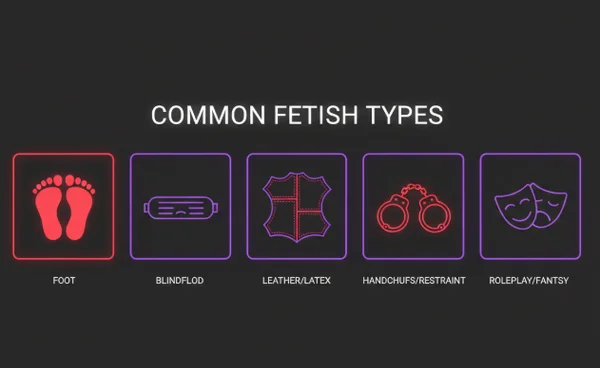
Not all fetishes are rare or extreme. In fact, many appear frequently in surveys and clinical literature. Here are some of the most commonly reported sexual fetishes.
Foot Fetishism (Podophilia)
Foot fetishism is widely considered the most prevalent sexual fetish. Research suggests it accounts for nearly 47% of all fetishes involving body parts. Attraction may center on the shape, size, or appearance of feet, or on activities like foot massages and toe play.
BDSM Fetishes — Bondage, Dominance, Submission, Masochism
BDSM encompasses a broad range of practices involving power exchange, restraint, and sensation play. Studies indicate that 65–69% of the general population has had at least one BDSM-related fantasy. Common BDSM fetishes include:
- Bondage — restraining or being restrained for arousal
- Dominance and submission (D/s) — one partner takes control while the other yields
- Sadism — deriving pleasure from consensually inflicting pain or intensity
- Masochism — deriving pleasure from receiving pain or humiliation
Clothing and Material Fetishes
Many people find specific fabrics or garments arousing. Lingerie, leather, latex, rubber, stockings, and high heels frequently appear in fetish research. In one review, clothing accounted for over 58% of reported object-based fetishes.
Voyeurism and Exhibitionism
Voyeurism involves arousal from watching others in intimate or sexual situations. Exhibitionism involves arousal from being watched or exposing oneself. When consensual — such as through agreed-upon scenarios — these interests fall within normal kink territory.
Role-Playing and Fantasy Scenarios
Role-play fetishes can range from teacher-student dynamics to elaborate costumed scenarios. These interests often overlap with power exchange and allow partners to explore sides of their personality in a safe, bounded context.
A Comprehensive List of Sexual Fetishes by Category
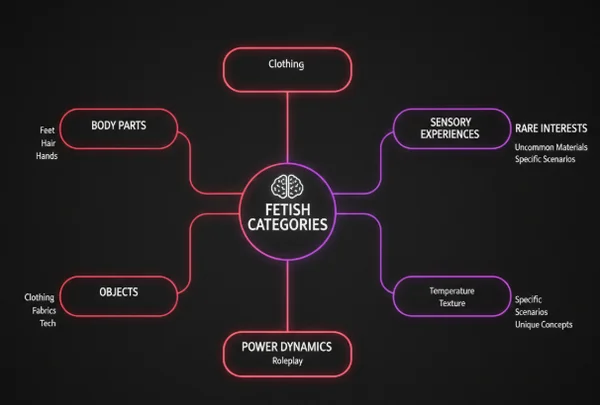
A complete list of sexual fetishes covers hundreds of interests. Below, this sexual fetish list is organized into clear categories so you can browse, learn, and understand the full spectrum.
Body Part Fetishes (Partialism)
These fetishes involve intense focus on a specific non-genital body part:
- Podophilia — feet
- Trichophilia — hair
- Maschalagnia — armpits
- Pygophilia — buttocks
- Nasophilia — noses
- Crurophilia — legs
- Hand fetish — hands and fingers
- Muscle worship — well-defined muscles
Object and Material Fetishes
These center on non-living objects or textures:
- Leather fetishism — leather clothing or accessories
- Latex/rubber fetishism — rubber or latex garments
- Shoe fetishism (Retifism) — shoes, especially high heels
- Lingerie fetishism — underwear, stockings, corsets
- Balloon fetishism (Looners) — balloons
- Diaper fetishism — diapers
- Olfactophilia — specific scents or body smells
Power Exchange and BDSM Fetishes
These involve dynamics of control, surrender, or intensity:
- Bondage — physical restraint with ropes, cuffs, or other tools
- Dominance/submission — structured power exchange
- Sadism/masochism — giving or receiving pain
- Orgasm control/denial — controlling a partner's climax
- Degradation/humiliation — consensual verbal or situational humiliation
- Wax play — dripping melted wax on skin
- Impact play — spanking, paddling, or flogging
- Pet play — role-playing as animals within a power dynamic
Sensation and Situational Fetishes
These fetishes are triggered by specific scenarios or sensory experiences:
- Voyeurism — watching others in intimate situations (consensual context)
- Exhibitionism — being watched during intimate acts (consensual context)
- Cuckolding — arousal from a partner being intimate with someone else
- Age play — role-playing different ages (all participants are consenting adults)
- Claustrophilia — arousal tied to confined spaces
- Aquaphilia — arousal connected to water scenarios
- Blindfold play — sensory deprivation enhancing other senses
Body Fluid and Biological Fetishes
These involve specific bodily substances or functions:
- Urophilia — urine
- Lactophilia — breast milk
- Eproctophilia — flatulence
- Menophilia — menstrual fluid
Rare and Unusual Fetishes
Some paraphilias appear less frequently but are documented in clinical literature:
- Acrotomophilia — attraction to people with amputations
- Abasiophilia — attraction to people with impaired mobility
- Formicophilia — insects crawling on the body
- Agalmatophilia — statues or mannequins
- Chremastistophilia — being robbed or held up
- Oculolinctus — licking eyeballs
- Mechanophilia — machines or vehicles
Important note: This list of sexual fetishes is intended for educational purposes. Inclusion on this list does not imply endorsement or encouragement. Any sexual activity must involve informed, enthusiastic consent from all parties.
What Causes Sexual Fetishes?
You might wonder why certain things become sexually charged. The honest answer is that researchers don't fully agree — but several theories offer useful frameworks.
Early Conditioning and Association
One widely discussed theory suggests that fetishes develop through classical conditioning. If a neutral object or scenario is repeatedly paired with sexual arousal during formative years, the brain may create a lasting association. For instance, someone who experiences arousal in connection with a specific material during adolescence might carry that association into adulthood.
Neurological Cross-Wiring
Some researchers point to the brain's sensory mapping. The areas processing genital sensation and foot sensation, for example, sit close together in the somatosensory cortex. This proximity may explain why foot fetishism is disproportionately common.
Psychological Factors
Emotional states, personality traits, and relational dynamics all play a role. Some people gravitate toward fetishes that address deeper psychological needs — like control, vulnerability, or novelty.
The Takeaway on Causes
No single explanation covers every fetish. For most people, these interests emerge naturally and don't signal anything harmful. If a particular interest causes you distress, speaking with a sex-positive therapist can help you gain perspective.
Are Sexual Fetishes Normal — and When Do They Become a Problem?
This is one of the most common questions people ask when browsing a list of sexual fetishes. The short answer: yes, having a fetish is quite common and usually perfectly healthy.
Where "Normal" Begins and Ends
Sexual interests exist on a wide spectrum. Research consistently shows that non-conventional desires are far more common than most people assume. Having a kink or fetish does not mean something is "wrong" with you.
The Clinical Boundary
A fetish crosses into clinical concern only when it meets specific criteria:
- It causes significant personal distress (not just social embarrassment)
- It impairs your relationships, work, or daily functioning
- It involves non-consenting individuals
When these conditions are met, the DSM-5 may classify it as a paraphilic disorder. Otherwise, it's simply an interest — one that many people share to varying degrees.
Shame vs. Self-Understanding
Shame is often the real problem, not the fetish itself. Cultural taboos and lack of education cause many people to feel isolated or "broken." Replacing judgment with accurate information is one of the most effective steps toward sexual well-being.
How to Explore Sexual Fetishes Safely With a Partner
Knowing about different sexual fetishes is one thing. Actually exploring them requires communication, trust, and clear boundaries.
Start With an Honest Conversation
Bring up the topic in a calm, private moment — not during sex. Use "I" statements: "I've been curious about…" rather than "We should try…". This lowers defensiveness and opens genuine dialogue.
Establish Boundaries and Safe Words
Before trying anything new, both partners should agree on:
- What's on the table and what's off-limits
- A safe word that immediately stops the activity
- A check-in process during and after the experience
Take It Slow
Exploration doesn't need to start at the deep end. Begin with lighter versions of an interest and gradually build from there. Pay attention to how each person feels — before, during, and after.
Consider a Self-Reflection Tool
If you're unsure where your interests actually lie, a structured self-reflection exercise can help you organize your thoughts. Tools like the BDSM quiz offer a private, judgment-free way to explore what resonates with you — without making any claims about who you are.
This tool is designed for self-exploration and education. It does not provide clinical assessments or diagnoses.
Understanding Your Desires — A Step Toward Self-Discovery
Browsing a comprehensive list of sexual fetishes and kinks can be eye-opening. However, reading about fetishes is different from understanding your own inner landscape.
Self-awareness is a powerful tool. When you understand your desires — without shame or pressure — you can make better decisions about intimacy, communication, and relationships. You might discover that some interests genuinely appeal to you while others simply satisfy intellectual curiosity, and both are completely fine.
If you'd like a guided starting point, the BDSM Test walks you through a series of reflective questions to help you understand your potential preferences. The experience is anonymous, private, and designed by professionals who approach this topic with care.
Results are a starting point for self-reflection — not a label or diagnosis. Consider discussing insights with a trusted partner or a qualified professional.
Key Takeaways Before You Go
Sexual fetishes are a natural part of the human experience. They span a massive range — from common interests like feet and BDSM to rarer paraphilias documented in clinical research. Here's what matters most:
- Fetishes, kinks, and paraphilias are different things — understanding the distinctions helps reduce unnecessary worry
- Most fetishes are completely normal — they only become clinical concerns when they cause distress or involve non-consent
- Communication and consent are non-negotiable — safe exploration starts with honest conversation
- Self-understanding beats self-judgment — replacing shame with knowledge leads to healthier relationships and better intimacy
- Professional support is always available — if any interest causes you distress, a sex-positive therapist can provide compassionate guidance
Frequently Asked Questions
What are the most common sexual fetishes?
Foot fetishism (podophilia) consistently ranks as the most common, followed by BDSM-related interests like bondage and dominance, clothing fetishes involving leather or lingerie, and voyeurism or exhibitionism within consensual contexts.
What is the difference between a fetish and a kink?
A kink is any non-conventional sexual interest that adds variety. A fetish is a stronger fixation where a specific object, body part, or scenario becomes central — sometimes necessary — for sexual arousal. Not every kink qualifies as a fetish.
Are sexual fetishes normal?
Yes. Research shows that non-conventional sexual interests are widespread. Having a fetish is only considered a clinical concern when it causes significant personal distress, impairs daily functioning, or involves non-consenting people.
When does a fetish become a disorder?
A fetish is classified as a paraphilic disorder under the DSM-5 when it persists for at least six months and causes marked distress, functional impairment, or involves harm to non-consenting individuals. Most fetishes never reach this threshold.
What causes someone to develop a sexual fetish?
No single cause has been confirmed. Leading theories include classical conditioning during formative years, neurological cross-wiring between adjacent brain regions, and psychological factors like personality traits or emotional needs. For most people, fetishes emerge naturally.
How can you talk to a partner about sexual fetishes?
Choose a calm, private moment outside of sexual activity. Use "I" statements to express curiosity without pressure. Listen actively to your partner's response, respect boundaries, and agree on safe words before trying anything new.
What is the difference between a paraphilia and a fetish?
A paraphilia is a broad clinical term for any atypical sexual interest. A fetish is a specific type of paraphilia focused on objects or non-genital body parts. All fetishes are paraphilias, but not all paraphilias are fetishes.
How many types of sexual fetishes exist?
There is no fixed number. Clinical literature documents hundreds of named paraphilias, and individual variations are essentially limitless. Major categories include body part fetishes, object fetishes, power dynamics, sensory experiences, and situational interests.