Fetish BDSM: Meaning, Examples, and Safe Self-Reflection
If you have searched for "fetish BDSM," you may be trying to sort out several overlapping words at once: fetish, kink, preference, and BDSM. They are related, but they do not mean the same thing. A fetish usually centers on a specific object, body part, material, scenario, or sensory cue. BDSM centers on consensual power exchange, roles, restraint, discipline, sadism, masochism, or related dynamics. A kink is broader than both, while a preference can be as simple as something you like without needing it to define your arousal or identity. If you want a private place to reflect on these differences, a safe BDSM self-reflection tool can help you organize your thoughts without turning curiosity into a permanent label.

What Fetish BDSM Means
"Fetish BDSM" is not one single category. In everyday search language, people often use it to mean one of three things.
First, it can mean a fetish that appears inside a BDSM scene or relationship. For example, a person might be drawn to a material such as latex, leather, fishnet, or certain fetish wear, and that interest may become part of a consensual power-exchange dynamic. The material is the fetish focus; the power dynamic is the BDSM context.
Second, it can mean a BDSM interest that has become highly specific. Someone may enjoy restraint in a broad way, while another person may feel especially drawn to a particular ritual, role, posture, sensation, or symbolic item. The more specific and central that focus becomes, the more likely people are to describe it as a fetish rather than a general BDSM kink.
Third, it can simply be a search phrase people use when they are not sure which word is correct yet. That uncertainty is normal. Human sexuality does not always organize itself into neat boxes, and the same interest can feel like a preference for one person, a kink for another, and a fetish for someone else.
The useful question is not "Which label is perfect?" The more helpful question is: what role does this interest play for you? Is it optional, central, emotional, sensory, relational, aesthetic, or tied to power exchange? That answer matters more than the label.
Fetish, Kink, Preference, and BDSM: The Practical Difference
A kink is a broad interest in something outside a person's usual or mainstream sexual pattern. It might involve roleplay, sensation, restraint, clothing, language, taboo, ritual, or power. Kink is the umbrella word many people use when they are still exploring.
A fetish is usually more focused. It often involves a specific object, body part, material, situation, or sensory detail that carries strong arousal or meaning. A foot fetish BDSM interest, for instance, may focus on feet, footwear, service, worship, control, humiliation, tenderness, or ritual depending on the people involved. The same surface topic can have very different emotional meanings.
A preference is lighter and more flexible. You can prefer a style of touch, clothing, role, or mood without needing it to be present. Preferences can become kinks, and kinks can sometimes feel fetish-like, but they do not have to.
BDSM is a framework for consensual activities and relationship dynamics involving power, control, restraint, discipline, dominance, submission, sadism, masochism, or role structure. BDSM may include fetishes, but it does not require them. Someone can enjoy BDSM for trust, surrender, structure, intensity, caretaking, aesthetics, emotional contrast, or communication without having a specific fetish.
Common BDSM Fetishes Without Turning Them Into a List of Rules
Many articles try to answer "what is BDSM fetishes" with a long BDSM fetish list. Lists can be useful for vocabulary, but they can also make exploration feel like a checklist to complete. A healthier approach is to group examples by the kind of meaning they often carry.
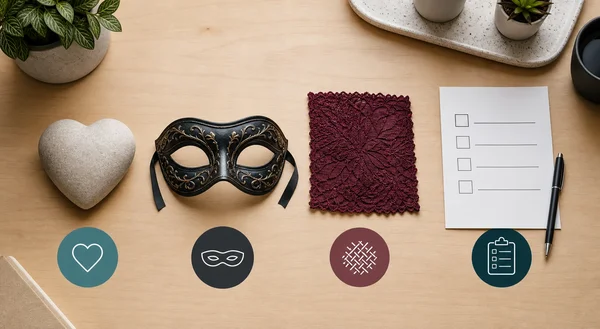
Material and clothing fetishes may involve latex, leather, fishnet, gloves, boots, uniforms, collars, or other BDSM fetish clothing. For some people, the draw is texture. For others, it is visual style, role symbolism, transformation, ritual, or the feeling of stepping into a different headspace. Fetish wear does not automatically mean someone wants a specific scene; it may simply be aesthetic or identity-based.
Body-part fetishes may focus on feet, hands, hair, muscles, or other features. A BDSM foot fetish can involve service, admiration, control, teasing, vulnerability, or sensory focus. The important part is that everyone involved understands what is being requested and what remains off-limits.
Roleplay and scenario fetishes can include medical fetish BDSM themes, authority dynamics, service roles, protocol, pet play, or other imagined settings. These themes require especially clear boundaries because words, costumes, and symbols can carry strong emotional weight. A fantasy can be meaningful without needing to be extreme.
Gear and toy interests may involve restraints, blindfolds, cuffs, impact tools, or sensation items. The object itself may be central, or it may be a support for a broader dynamic. A person searching for BDSM fetish toys or BDSM fetish gear may be curious about equipment, but safety knowledge and consent skills matter more than owning any item.
There are also search phrases around porn, dating, escorts, or stores. Those are different intents from an informational guide. This article stays focused on education, self-reflection, consent, and safer language for adults who want to understand their interests.

How to Explore a BDSM Fetish Safely
The safest starting point is not performance. It is language. Try writing a few simple notes before you involve another person:
- What exactly draws my attention: object, material, body part, role, mood, or power dynamic?
- Is this optional, important, or central for me?
- What feels exciting in fantasy but not acceptable in real life?
- What limits would I need to protect my physical and emotional safety?
- What would aftercare, privacy, and a respectful stop signal look like?
If a partner is involved, discuss the interest outside the heat of the moment. Use plain language. Instead of saying "I want to try a fetish scene," explain what you mean: "I am curious about the feeling of service," "I like the look of latex," "I want to talk about foot-focused play," or "I am interested in a light power-exchange role." Specific language reduces pressure and makes consent easier to give, refuse, or revise.
For physical activities, begin with low-intensity versions. Do not copy extreme content from porn or social media. Many risky activities look simple from the outside but require experience, anatomy awareness, emergency planning, or community education. If something involves breathing, circulation, sharp objects, intense pain, substances, emotional degradation, or trauma-related themes, treat it as advanced and do not improvise.
For identity and self-understanding, remember that a BDSM preference quiz can be a reflection aid, not a final answer. Your interests can change with trust, age, stress, relationship context, body comfort, and life experience. The goal is not to prove a fixed type. The goal is to notice patterns with honesty and care.
When a Fetish Feels Confusing, Shameful, or Too Important
Some people feel relief when they discover a name for an interest. Others feel anxious, especially if the fetish seems taboo, intense, or hard to explain. Shame often grows when curiosity has no safe language. Naming an interest does not mean you must act on it, disclose it to everyone, or make it part of your identity.
It may help to separate three layers.
Fantasy is what your imagination finds compelling. Fantasy can be symbolic, exaggerated, impossible, or emotionally charged. It does not automatically equal a real-life plan.
Desire is what you may want to explore under the right conditions. Desire needs context: trust, privacy, consent, timing, emotional readiness, and practical safety.
Behavior is what you actually choose to do. Behavior should be consensual, legal, adult, negotiated, and reversible. You can respect a fantasy without acting it out. You can also explore a desire slowly without turning it into a lifestyle.
If an interest causes distress, feels compulsive, interferes with everyday life, or connects to painful experiences, consider speaking with a qualified, kink-aware professional. That support is not about shame. It is about having a calm place to think clearly.

A Gentle Next Step for Fetish BDSM Self-Reflection
If you are trying to understand a fetish BDSM interest, keep the next step small. You do not need a dramatic reveal, a perfect label, or a complete plan. Start by naming the focus, noticing whether it is optional or central, and writing down the boundaries that would make any exploration feel respectful.
Then compare the interest with nearby categories. Is it mostly a sensory preference? A kink you enjoy sometimes? A fetish that feels highly specific? A BDSM dynamic involving trust, surrender, structure, or control? Those distinctions can help you communicate more clearly with yourself and, if relevant, with a partner.
For private reflection, an anonymous kink exploration resource can give you language to consider your roles, boundaries, and preferences at your own pace. Use any result as a conversation starter with yourself, not a verdict. In BDSM and fetish exploration, self-knowledge works best when it stays flexible, consensual, and kind.
FAQ
What is the meaning of fetishism?
Fetishism usually refers to strong arousal, attraction, or symbolic meaning connected to a specific object, material, body part, scenario, or sensory cue. In everyday conversation, people may use "fetish" more loosely. The key idea is focus: the interest is more specific than a broad preference.
What is the difference between BDSM and a fetish?
BDSM is a framework of consensual power exchange, roles, restraint, discipline, dominance, submission, sadism, masochism, or related dynamics. A fetish is a specific focus. A fetish can appear inside BDSM, but BDSM does not require a fetish, and a fetish does not automatically involve BDSM.
What is an example of a dirty kink?
"Dirty kink" is casual language, not a formal category. People may use it for consensual dirty talk, taboo roleplay, light power exchange, or sensory play that feels naughty to them. The word "dirty" should not mean harmful or shameful. Consent, adult participation, and boundaries still come first.
What is the difference between a kink and a preference?
A preference is something you like. A kink is usually a more distinctive interest outside your usual or mainstream pattern. A preference might be optional, while a kink may feel more emotionally or erotically charged. The boundary is personal, and it can shift over time.
Can a BDSM fetish change over time?
Yes. Interests can become stronger, softer, more specific, less important, or more contextual. Trust, relationship dynamics, stress, privacy, body image, culture, and experience can all affect how a fetish or kink feels.
Is a BDSM fetish the same as a BDSM test result?
No. A test result can suggest language for roles or preferences, but it cannot capture your full inner life. Treat any result as a starting point for reflection, communication, and further learning rather than a fixed identity.
How do I talk to a partner about a fetish?
Choose a calm moment outside sexual activity. Describe the interest plainly, explain what appeals to you, name what you are not asking for, and invite your partner to share their feelings. A respectful "no" or "not yet" should always remain available.