Evaluating the Kink Orientation Scale: A Psychological Framework for Self-Discovery
Exploring your intimate desires can often feel overwhelming, especially when you are trying to find the right words to express them. Understanding your own preferences is a deeply personal process, and our comprehensive kink orientation scale guide is designed to help you navigate this journey with clarity and confidence.
For many people, understanding their own preferences requires more than just a passing thought. Traditional quizzes often fail to capture the nuanced realities of power exchange, sensory desires, and emotional boundaries. However, an in-depth orientation scale changes this dynamic. Whether you are curious about your own hidden traits or looking for a healthier way to communicate with a partner, this framework offers a structured, psychological approach to mapping your unique intimacy profile safely.
This guide will break down the specific dimensions of the scale. We will also explain how to interpret your results for personal growth. Ultimately, you will learn how to use this self-discovery tool to build better, more consensual relationship dynamics.

What is the Kink Orientation Scale?
The kink orientation scale is an educational tool used to measure and categorize intimate preferences along a flexible spectrum. It does not label you with a permanent identity. Instead, it provides a vocabulary for the desires, boundaries, and roles you might enjoy in a safe environment.
When you engage with the kink orientation scale, you are essentially creating a map of your internal landscape. This map helps you understand what excites you, what feels safe, and where your hard limits lie. Therefore, it is a tool for empowerment rather than judgment.
The Psychology Behind Preference Profiling
At its core, preference profiling is about self-awareness. Psychologists and sex educators emphasize that human sexuality is incredibly diverse. Consequently, grouping desires into a psychological framework helps normalize them.
When you use an orientation scale, you organize abstract feelings into concrete data points. For example, you might realize that your desire for control is actually linked to a need for emotional safety. Profiling kink preferences allows you to observe these patterns objectively. As a result, you can reduce any feelings of shame or confusion associated with unconventional desires. It is simply a method of gathering data about your own mind.
How an Orientation Scale Differs from a Binary Kink Test
Many online quizzes rely on a simple "yes or no" format. While these binary tests are fun, they lack depth. An orientation scale, on the other hand, measures intensity and context.
- Binary Tests: These ask if you like a specific activity. You either answer yes or no. They do not account for your mood, your partner, or the environment.
- Orientation Scales: These use a sliding spectrum. You might indicate that you strongly agree with a statement under certain conditions.
This spectrum approach is crucial. It acknowledges that you might enjoy a submissive role in the bedroom but a dominant role in daily life. By capturing these nuances, the kink orientation scale framework provides a much more accurate reflection of your true self.
Understanding the Dimensions of the Kink Orientation Scale
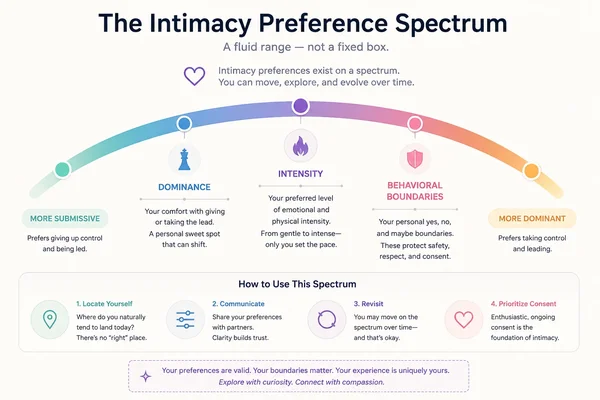
To truly benefit from this framework, you need to understand what it actually measures. The scale breaks down complex human desires into specific, measurable categories. Two of the most common metric frameworks used in these assessments are the BEND dimensions and the DI dimensions.
By analyzing these specific areas, the scale helps you pinpoint exactly where your interests lie.
Decoding the "BEND" Dimensions
The BEND dimensions serve as the foundational pillars of many intimacy profiles. This acronym breaks down the broad spectrum of kink into four manageable categories.
| Dimension | Focus Area | What it measures |
|---|---|---|
| Behavioral | Restriction | Physical control, rules, and limits. |
| Emotional | Trust | Connection level and psychological safety. |
| Novelty | Roleplay | Scenarios, personas, and theatrical play. |
| Dominance | Power | Natural inclination to lead or follow. |
Understanding these bend dimensions helps you see that kink is not just one thing. It is a combination of physical, emotional, and psychological factors.
The Role of "DI" Bend Dimensions in Power Exchange
Within the broader scale, you will often find specific sub-metrics. The "DI" bend dimensions are particularly important for understanding power exchange. DI typically stands for Dominance and Intensity.
- Dominance: This measures your baseline desire to lead, guide, or control a situation. However, it also measures your capacity to care for the person submitting to you.
- Intensity: This measures the level of sensory or psychological stimulation you crave. Some people want high dominance but low physical intensity.
By separating Dominance from Intensity, the DI dimensions prevent dangerous misunderstandings. The scale makes these crucial distinctions clear for your personal development.
How to Interpret Your Kink Orientation Scale Questionnaire Results
Taking the assessment is only the first step. The real value comes from interpreting your kink orientation scale questionnaire results. It is important to approach your profile with an open mind.
Remember, there are no "wrong" or "failing" scores. Your results are simply a snapshot of your current desires. They provide a safe starting point for deeper self-reflection.
Analyzing High, Low, and Fluid Scores
When you receive your results, you will likely see a mix of different scores across various dimensions. Here is a general guide on how to interpret them safely:
- High Scores: A high score indicates a strong, consistent preference. This is an area you might want to explore further.
- Low Scores: A low score simply means a lack of interest. It does not mean you are repressed; it just indicates that those specific activities do not resonate with you.
- Mid-Range or Fluid Scores: If you score perfectly in the middle, you might be a "switch." This means you can enjoy both sides of a dynamic. Fluid scores highlight a high degree of versatility in your intimate life.
Recognizing That Kink Profiles Can Evolve Over Time
One of the biggest mistakes people make is treating their results as a permanent label. Human sexuality is incredibly fluid. Therefore, recognizing that kink profiles can evolve over time is essential for healthy self-discovery.
Your preferences today might look very different five years from now. Life experiences, trauma healing, aging, and finding new partners can all shift your desires. If you retake the questionnaire a year later, do not be surprised if your bend dimensions have changed. This evolution is entirely normal. The scale is a living document of your journey, not a rigid box you must fit into forever.
Navigating Relationship Dynamics with Your Scale Profile
Self-discovery is wonderful, but intimacy usually involves another person. The kink orientation scale is an incredible tool for navigating relationship dynamics. It takes the guesswork out of communication.
When both partners understand their unique profiles, they can bridge gaps in their desires. This framework provides a neutral, objective language to discuss highly sensitive topics.

Using the Scale to Establish Safe Boundaries
Safety is the most important aspect of any intimate exploration. You can use your scale results to create a clear checklist for boundary setting.
- Identify Hard Limits: Look at your lowest scores. These are likely your hard limits. Clearly communicate these to your partner before any intimate play begins.
- Define Soft Limits: Look at your mid-range scores. These are activities you might try under the right, highly trusted conditions.
- Plan for Aftercare: Based on your emotional exchange score, decide what kind of aftercare you need. High emotional scorers might need verbal affirmation, while physical scorers might just need a warm blanket.
- Establish a Safe Word: Always agree on a clear, unmistakable safe word to pause or stop activities instantly.
By turning your profile into an actionable safety checklist, you protect both your physical and emotional well-being.
Sharing Your Results for Non-Judgmental Exploration
Talking about deep desires can be terrifying. However, sharing your results provides a structured way to start the conversation.
Instead of saying, "I have a weird fantasy," you can say, "I took an assessment, and I scored really high in the novelty dimension. Can we look at this together?" This removes the pressure and makes the conversation educational. If you want to explore your preferences with our kink orientation scale, you can compare your profiles side-by-side.
Look for areas of high compatibility. Next, look for areas where you differ. You do not have to match perfectly to have a great relationship. You just need to understand where the other person is coming from.
Taking the Next Step in Your Journey of Self-Discovery
Now that you understand the psychological framework, you might be wondering what to do next. Reading about intimacy is helpful, but active self-reflection is where real growth happens.
Moving from theory to practice requires a safe, low-pressure environment. You do not need to rush into any physical activities. Instead, focus on organizing your thoughts and validating your internal experiences.
Using Online Tools for Private Self-Reflection
If you are ready to map out your own intimacy profile, utilizing an online self-discovery tool is the perfect next step. A well-designed tool allows you to answer sensitive questions in complete privacy.
When you use a platform designed for educational purposes, you eliminate the fear of judgment. Here is a simple step-by-step approach to taking your assessment:
- Find a Quiet Space: Ensure you are in a private, relaxed environment.
- Be Brutally Honest: The results are only for you. Answer based on what you truly feel.
- Review the Breakdown: Once you finish, read through the explanations of your specific dimensions carefully.
- Reflect Without Judgment: Give yourself a few days to process the information before taking any external action.
Try the kink orientation scale online to establish a baseline for your personal journey. It is a gentle way to say "yes" to knowing yourself better.
Embracing Your Kink Orientation Safely and Confidently
Understanding your intimate preferences is a powerful act of self-acceptance. The kink orientation scale provides the language and the framework you need to explore your desires without fear. By decoding dimensions like BEND and DI, you gain crystal-clear insight into your behavioral boundaries and power dynamics.
Remember that your results are a map, not a mandate. Your desires will likely shift and evolve, and that is a beautiful part of the human experience. Always prioritize Safe, Sane, and Consensual (SSC) practices in your explorations. Embrace your journey with an open mind, and always communicate your boundaries with kindness and clarity.
Frequently Asked Questions
Why is a self-discovery scale not considered a clinical diagnostic tool?
A self-discovery scale is strictly an educational tool designed for personal reflection. It maps your subjective preferences, fantasies, and boundaries. It does not diagnose medical conditions or psychiatric disorders. If your intimate desires are causing you severe distress, seek support from a kink-allied therapist rather than relying on an online questionnaire.
How accurate is a self-reported kink questionnaire?
The accuracy depends on your honesty during the reflection process. These scales provide a subjective baseline for personal exploration rather than an objective scientific measurement. They are excellent educational aids, but you remain the final authority on your own identity.
Can my orientation scale results change over time?
Yes, absolutely. Human sexuality and intimate preferences are naturally fluid. It is entirely normal for your results to evolve as you age, gain new experiences, or enter different relationships. Your profile is a snapshot of your current state of mind, not a permanent label.